

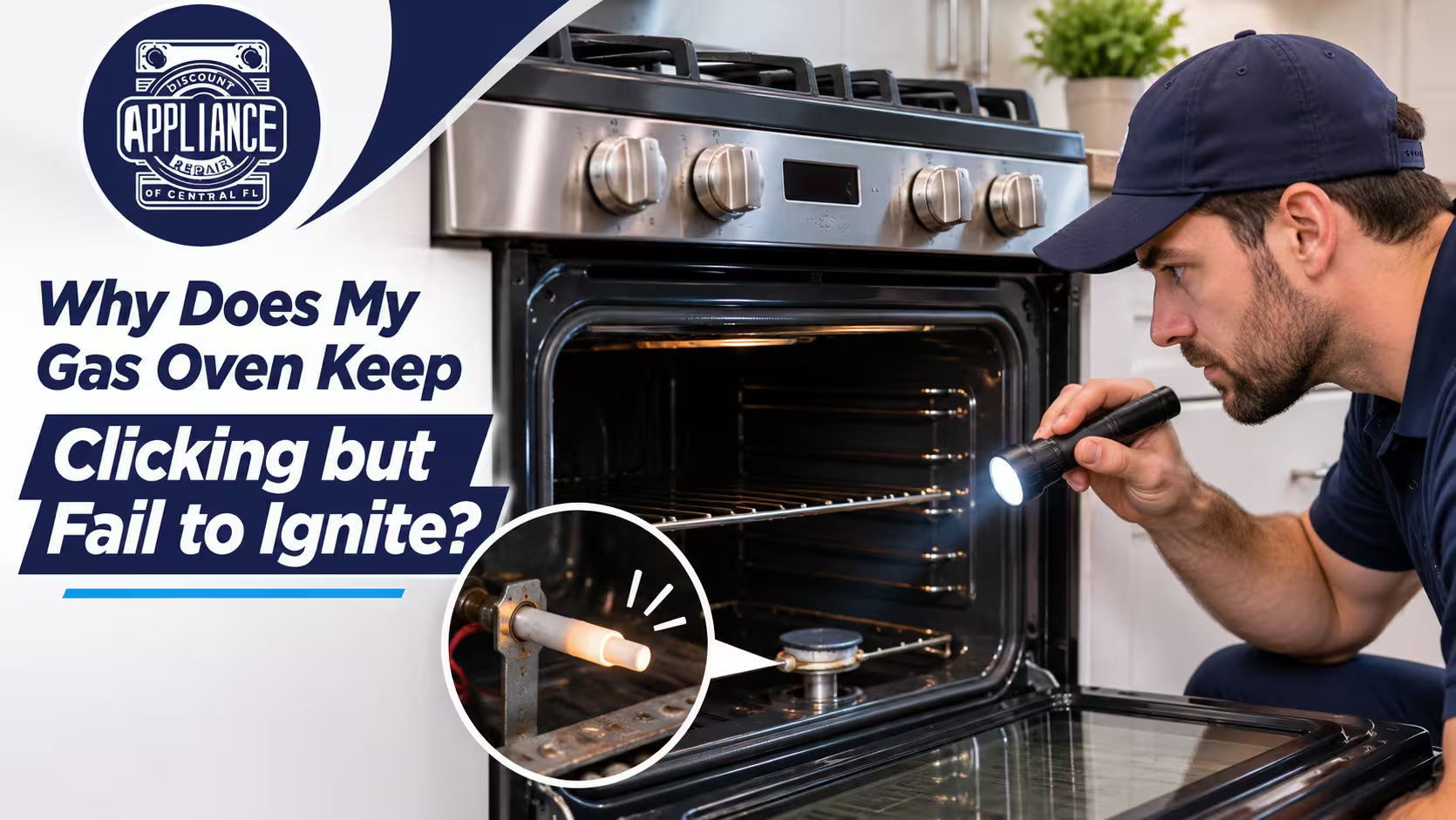


You turn on your gas oven to prepare dinner, hear repeated clicking sounds, and wait for the burner to ignite. A few seconds pass, but the oven remains cold. You try again, only to hear the same clicking without a flame. When this happens, the ignition system may be attempting to light the burner but failing to complete the process.
A gas oven clicking but not igniting can have several causes, including a faulty spark igniter, moisture around ignition components, a blocked burner, interrupted gas supply, or a problem with the ignition control system. Understanding what happens during ignition helps identify why the oven fails to start heating.
How a Gas Oven Ignition System Works
A gas oven must complete an ignition sequence before it begins heating. However, not all gas ovens use the same ignition technology.
| Ignition type | How it works |
| Spark ignition | An electrode creates a spark near the burner to ignite the gas. |
| Hot-surface ignition | An igniter heats up to a specific temperature before the gas ignites. |
In spark-ignition models, clicking may be heard while the system generates a spark. On hot-surface models, the igniter may glow instead of producing clicking sounds. A brief ignition sound during startup may be normal. Repeated clicking without a flame, however, means the ignition sequence is not completing properly.
Common Reasons a Gas Oven Clicks but Does Not Ignite
Several components must work together to establish a flame. A failure in any part of that process may prevent the oven from starting.
| Possible cause | What may happen |
| Faulty spark electrode | The electrode produces a weak, inconsistent, or misplaced spark. |
| Moisture around ignition components | Water interferes with electrical ignition or spark generation. |
| Blocked burner openings | Gas cannot distribute properly across the burner. |
| Gas supply interruption | The burner does not receive sufficient gas for ignition. |
| Faulty ignition module | The system fails to generate or control the ignition sequence correctly. |
| Control board malfunction | Electronic signals required for ignition may not be delivered properly. |
A clicking sound alone cannot confirm which component has failed. The ignition system, burner, gas supply, and electrical controls must work together.
Could Moisture or Food Debris Be Preventing Ignition?
Spills, overflowing dishes, and cleaning liquids may reach areas around the oven burner or ignition components. Moisture can interfere with electrical operation, while grease and food debris may obstruct burner openings.
This is more likely to become noticeable after cleaning or a recent spill.
Signs that contamination may be involved include:
- Clicking began after the oven was cleaned.
- The ignition problem appeared following a food spill.
- The oven worked normally before moisture entered the burner area.
- The ignition problem occurs intermittently rather than during every startup.
Turn the oven off and allow it to cool completely. Do not remove internal components or repeatedly restart the oven while the affected area may still be wet.
What Can You Check Before Scheduling a Repair?
A few basic observations may help narrow down the problem without exposing the homeowner to gas or electrical hazards.
- Confirm the settings: Make sure the bake function and desired temperature are selected correctly.
- Notice the clicking pattern: Does it begin immediately, continue without stopping, or end without ignition?
- Consider recent spills: Think about whether cleaning, moisture, or food overflow occurred before the problem started.
- Check other gas appliances: If other gas appliances are also not working, the issue may involve a wider gas supply interruption.
Do not remove burner assemblies, disconnect wiring, adjust gas pressure, or attempt to test gas valves yourself.
What the Symptoms May Reveal About the Ignition Problem
The behavior of the oven may provide useful clues about where the ignition sequence is failing.
| Symptom | Possible explanation |
| Clicking but no flame | Spark electrode, burner, or gas flow problem |
| Clicking stops without ignition | Ignition system failed to establish a flame |
| No clicking or glowing | Igniter, electrical connection, or control issue |
| Ignition works occasionally | Intermittent component fault or contamination |
| Oven repeatedly attempts ignition | Ignition sequence is not completing successfully |
These symptoms are clues, not confirmed diagnoses. For example, an oven that clicks but does not light may have an electrode problem, but a gas supply or burner issue can produce similar behavior.
When Clicking Becomes a Gas Safety Concern
Repeated ignition attempts should not be ignored. If gas is released but does not ignite, unburned gas may accumulate around the appliance.
If you smell gas:
- Stop using the oven immediately.
- Do not attempt another ignition.
- Do not operate electrical switches or turn appliances on or off.
- Leave the building and move to a safe location.
- Contact the gas supplier or emergency services from outside.
If there is no gas odor but the oven repeatedly clicks without lighting, stop using it and arrange an inspection. Continued ignition attempts are not a safe way to troubleshoot the appliance.
What a Technician Checks During Gas Oven Repair
A technician follows the oven’s ignition sequence to determine where the failure occurs rather than replacing parts based only on the clicking sound.
The inspection may include:
- Ignition testing: Checking whether the spark electrode or hot-surface igniter operates correctly.
- Burner inspection: Examining burner openings, positioning, and possible obstructions.
- Gas supply evaluation: Checking whether the oven receives the required gas supply.
- Electrical diagnosis: Inspecting ignition wiring, connections, modules, and control signals.
- Safety component testing: Verifying the proper operation of the gas safety valve and related controls.
The testing process depends on the oven model and ignition design. Correct diagnosis helps identify the actual failure instead of replacing components unnecessarily.
Discount Appliance Repair of Central Florida diagnoses gas oven ignition problems by checking igniters, burner assemblies, gas supply conditions, safety components, and ignition controls to identify why the appliance fails to light.
Frequently Asked Questions
Why does my gas oven keep clicking but never lights?
A faulty electrode, moisture, blocked burner openings, gas supply interruption, or ignition control failure may prevent the burner from lighting.
Is it normal for a gas oven to click during startup?
Some spark-ignition ovens click briefly during the ignition process. Clicking that continues without a flame or occurs during repeated failed starts is not normal operation.
Can a wet igniter stop my gas oven from igniting?
Yes. Moisture around ignition components may interfere with electrical operation or spark generation, preventing the burner from lighting.
Why do my stovetop burners work but my oven does not?
The oven may use a separate igniter, burner, safety valve, or gas shutoff arrangement. Working stovetop burners do not rule out an oven-specific ignition problem.
Should I keep restarting an oven that will not ignite?
No. Repeated ignition attempts may allow unburned gas to accumulate. Stop trying to ignite it, especially if you notice a gas odor, and follow gas safety guidance.
Final Thoughts: Understanding Gas Oven Ignition Failure
A gas oven that clicks but does not ignite may have an electrode problem, moisture contamination, blocked burner openings, interrupted gas flow, or a control system fault. Identifying the cause of ignition failure is the first step toward restoring normal operation without creating additional safety risks.
In Apopka, Discount Appliance Repair of Central Florida handles gas oven ignition problems by inspecting the igniter, burner assembly, gas supply, safety components, and ignition controls. Proper diagnosis helps address the underlying fault and restore reliable oven operation.